Start Fencing the Right Way: Why Private Lessons From Day One Matter
Every parent who walks into Lilov Fencing Academy asks some version of the same question: how should my child begin? The short answer is a simple formula that has worked for our beginners for years: at least two group classes per week, plus private lessons from the very beginning.
Plenty of happy, successful fencers start in group classes alone, and that is a perfectly good way to begin. But if you want your child to build correct habits from the first week, private lessons are the fastest way to get there. Here is why.
The first few months decide a lot
Fencing is a sport of reactions. Your child’s body will learn to answer an attack, a feint, or a change of distance without time to think. The question is which answers it learns.
A beginner who gets only a small share of a coach’s attention in a group setting will still learn, but will be reacting on raw instinct, and the reactions they settle into are often wrong. A child who feels threatened by an incoming blade might pull back, flinch, stiffen the arm, or reach with the upper body instead of moving the legs. Those reactions feel perfectly sensible to a seven- or ten-year-old. They are also exactly what a coach has to undo later.
With a coach working one-on-one from the first week, those raw instincts are replaced with correct reactions before the wrong ones take hold. The child learns the correct response while the habit is still soft.
Bad habits are easy to build and hard to fix
Every coach in every sport has seen this: a habit practiced a few hundred times is annoying to change. A habit practiced a few thousand times is part of the athlete.
In a group class, a coach is watching a dozen fencers at once. Even the best coach can’t correct every small error on every repetition. A private lesson changes the math. The coach sees every movement, stops the mistake immediately, and has the child repeat it correctly, right then, while it counts.
Kids who start without individual coaching can pick up habits that are harder to fix later, and “later” often arrives when they begin competing and the habit shows up under pressure. Those habits can be corrected at any stage, but it takes more time and repetition than building them right the first time.
Technique is what makes execution work
At its core, a private lesson is a technique lesson. Footwork, grip, blade control, the timing between the arm and the legs: these are the details a coach can only shape when the whole lesson is focused on one fencer.
This matters because without technique, execution suffers. A child can understand exactly what to do, see the opening, and make the right decision, and still lose the point because the action arrives late, short, or off target. Fitness, tactics, and confidence all depend on a body that can carry out the movement cleanly. Technique is what turns a good idea into a hit.
Technique is shaped in private lessons because that is where the coach can watch every repetition and correct it in the moment. Group classes are where that technique gets practiced and tested, but shaping it takes a coach’s full attention on one fencer.
A private lesson lets the coach fit the actions and technique to your child. Every fencer has different strengths: some are fast, some are tall with a long reach, some are patient and precise. In a one-on-one lesson, the coach can choose the actions and the technique that suit your child’s abilities and build on what they already do well, instead of teaching everyone the same thing.
Think of it like music lessons
No one expects a child to learn piano just by copying the classmate next to them. A teacher sits beside the student and shapes the details: how the hand is held, where the fingers fall, how the wrist moves. Left alone, a beginner invents a way to play. A teacher gives them the way that works. A good teacher also trains the sense of rhythm: to feel the beat, hold a steady tempo, and change it on purpose.
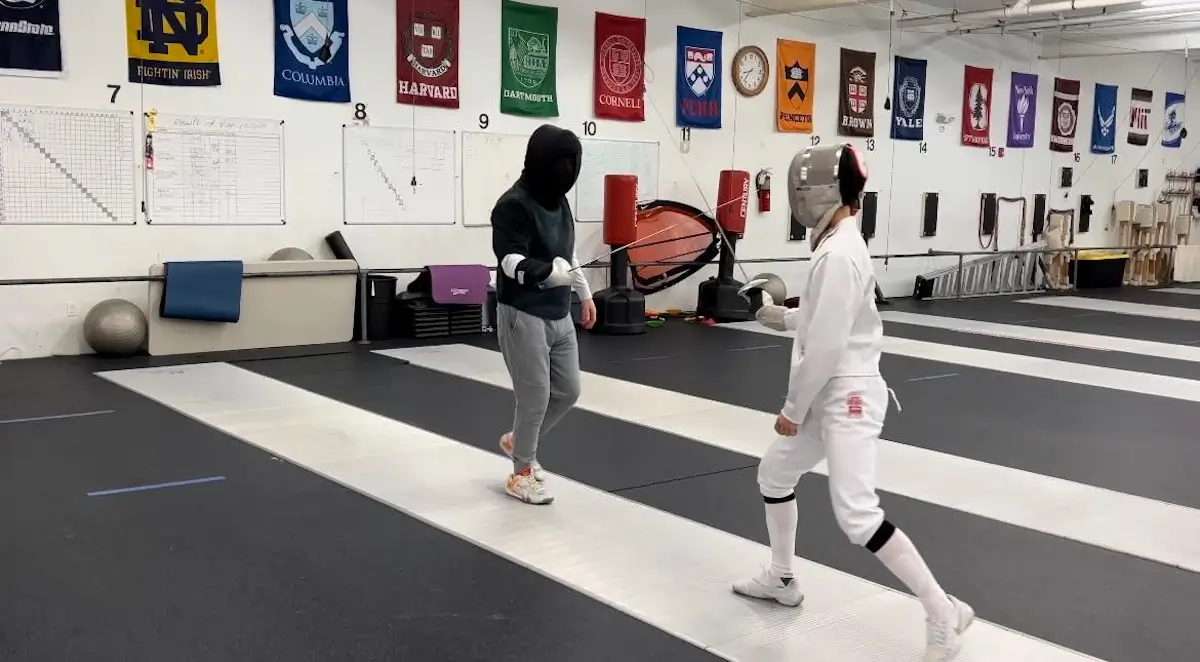
Fencing private lessons work the same way. An experienced coach will, quite literally, mold your child’s hand: the grip, the finger pressure, the line of the blade. Just as importantly, the coach does three things that are hard to do any other way:
- Converts instinct into correct reactions. Instinct is hard to argue with, so the coach replaces it with correct reactions, repeated until they become automatic.
- Builds a feeling for distance and tempo. Distance and tempo are the heart of fencing. Knowing, without looking, whether you are in range, out of range, or one step from it, and knowing when to start, how fast to go, where to pause, and when to accelerate, is a skill built through hundreds of precise repetitions with a partner who adjusts to you. A correct movement at the wrong moment still fails. Over time, the right timing becomes as automatic as the right reaction. That is exactly what a private lesson gives.
- Sets the standard for what “right” feels like. When a child knows how a correct action feels, they can recognize and correct themselves in group drills and bouts.
Private lessons and group classes do different jobs
We’re not suggesting private lessons replace group classes. They complement each other.
Group classes give your child energy, friends, footwork drills, conditioning, and the chance to try their skills against other fencers. They are also where fencing becomes fun and social.
Private lessons give your child precision. They are where technique is shaped and corrected, and where the details get built and the habits get formed.
Many children spend their first year in group classes only, and they enjoy it, make friends, and improve. Private lessons are not a requirement for belonging at LFA. They are an accelerator: a way to build precise technique earlier, and a good option to add at any point, whether in week one or month six.
What a good start looks like
- Start with at least two group classes per week. This builds the base: movement, stamina, and love of the sport.
- Add private lessons from day one if you can. Even a modest amount early on pays off, because correct habits get formed instead of repaired.
- Add more as your child progresses. As technique develops and goals become clearer, many families add private lessons and extra group sessions to build technique and conditioning. Competitive fencers train considerably more than beginners, but they get there step by step.
Our average new fencer starts around ages 10 to 12, and we welcome beginners from age 7. It’s never too late to start fencing, but the earlier habits are formed correctly, the more time your child spends building skill instead of rebuilding it.
A fair caveat
Private lessons don’t guarantee a champion, and they don’t replace your child’s effort, practice, or enthusiasm. Some children thrive in group classes alone; some families have budget or schedule limits, and some kids just want to try the sport first. All of that is fine. What we can say is that if you’re deciding where to invest early on, individual coaching is where it tends to have the most impact, and you’re welcome to add it whenever you’re ready.
Try a lesson
The best way to see how this works is to experience it. Book a trial private lesson and let your child try fencing with a coach who can show them what a correct start feels like.
Book a trial private lesson at lilovfencing.com
Allez!
Coach Serge, Lilov Fencing Academy