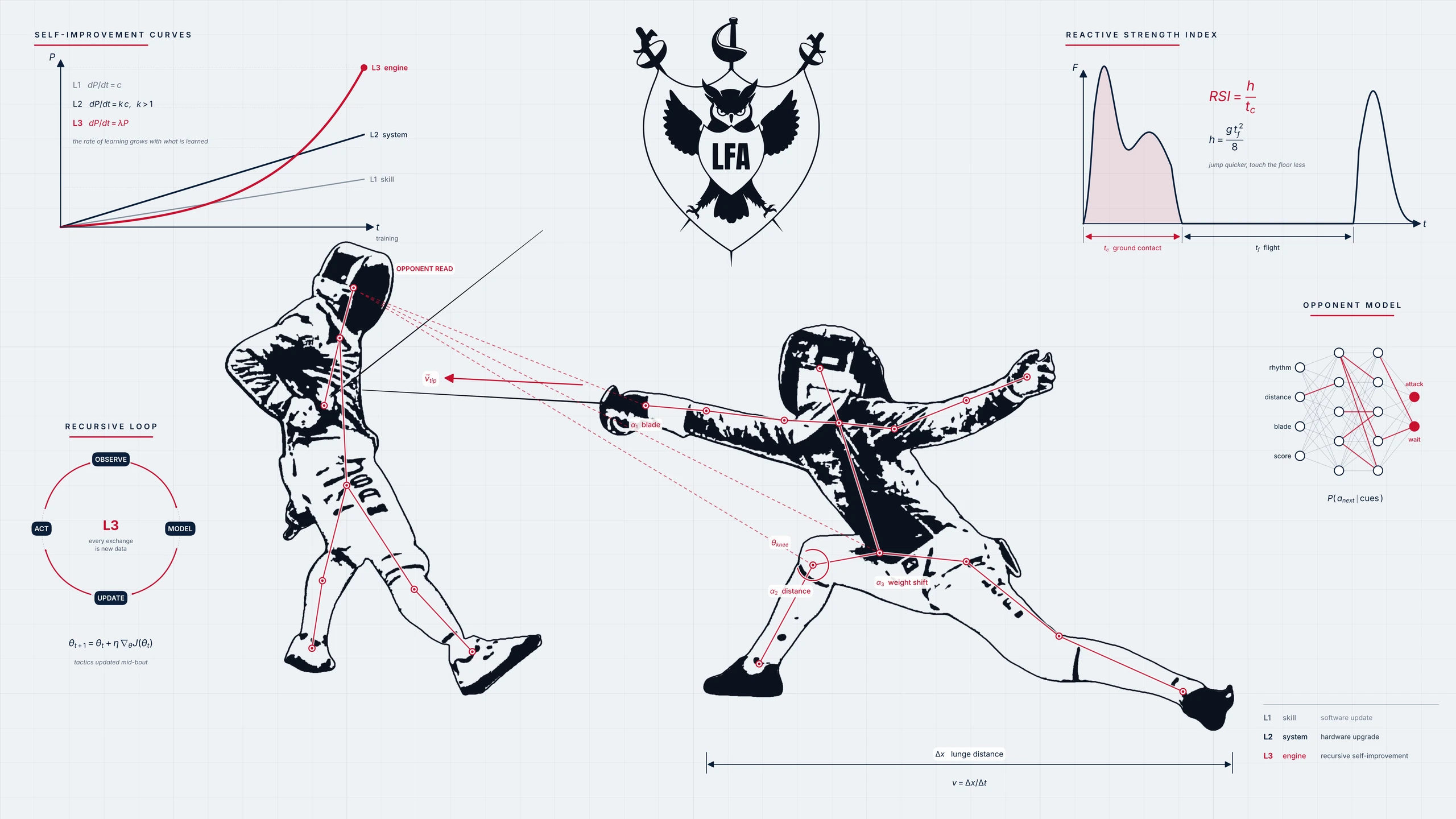
From Beginner to Olympian: The Three Levels of Fencing Self-Improvement
Two Kinds of RSI (when your kid’s coach and your tech team use the same acronym)
In AI, RSI means recursive self-improvement: a system that gets better at getting better. In sports science, it means Reactive Strength Index: jump height divided by ground contact time. A fencer’s path through the levels of fencing, from first lesson to the Olympics, needs both, and each stage changes what is being improved.
A note on ages: the stages below are typical paths, not deadlines. Every age group has outliers. There is the 12-year-old who reads bouts like a veteran, the teenager who starts at 15 and makes a national team, and the gifted athlete who plateaus until tactics click. Our parents’ guide Training Hard, Not Winning Yet covers that patience.
Age, rating and technical maturity don’t always move together. A fencer can be physically advanced but tactically inexperienced, or technically excellent with little tournament experience.
Level 0: Installing the Operating System
What it looks like: En garde, advance, retreat, lunge, distance, target, and the rules of the weapon. Examples include holding a low, balanced stance through a full drill, retreating without crossing the feet, and keeping distance from a partner who moves unpredictably.
The AI parallel: Installing the OS. Bugs here — a stance too upright, a back foot turned out — crash everything built on top for years.
Typical stage: First classes and local events. Every competitor starts unrated (U).
The objective: build sound movement patterns that everything else can rest on.
Level 1: Upgrading a Skill
What it looks like: An hour on one action. Examples include a parry-riposte, a beat attack, a counterattack to the wrist in epee, or a fleche in epee. Sabre forbids crossing the feet forward, so sabre fencers learn the flying lunge instead.
The AI parallel: A software update. The fencer adds one new function, but the processing stays the same. They now own the riposte, yet still choose it slowly and consciously.
Typical stage: Y-10 and Y-12, earning first E and D ratings.
The objective: build reliable actions, and learn when to use them.
Level 2: Upgrading the System
What it looks like: Training the body beneath every move. Reactive Strength Index rises by jumping quicker: spending less time on the ground. For a fencer, that is the explosive push out of en garde. Examples:
- Drop jumps and hops for leg elasticity
- Footwork ladders and reaction drills (attack on a visual signal)
- Single-leg strength for the lunge and the recovery
- Conditioning to keep that speed through a 15-touch elimination bout
The AI parallel: A hardware upgrade. Faster processing improves every technique already installed. The same riposte arrives sooner, and the same lunge covers more ground. But hardware alone can’t make bad software good: extra speed only helps with sound technique and timing.
Typical stage: Y-14 and Cadet, D to C ratings, regional and national events. Jump training for children should be low-volume, coached, and matched to growth.
The objective: upgrade the physical system that executes the technique.
Level 3: Upgrading the Learning Engine
What it looks like: Rewriting decisions mid-bout. Examples:
- Noticing an opponent always lunges on their third advance, and setting a counter-time trap there
- Using false attacks to see which parry they take, then finishing where that parry isn’t
- Changing tempo after a break once the opponent has solved your rhythm
- Fencing differently at 14–13 than at 5–5, because the opponent’s habits change under pressure
The AI parallel: True recursive self-improvement. Each exchange is data, and the fencer updates the tactical model in real time. It looks like mind-reading. What they actually read is preparation — a weight shift, a blade position, a choice of distance — before the opponent commits. For more on fencing as decision-making, see Before There Was AI, There Was the Fencer’s Mind.
Typical stage: Junior and Senior, B and A ratings, national teams, Olympians.
The objective: recognize patterns, test ideas, and adapt tactics under pressure.
The Levels of Fencing at a Glance
| Level | What you train | AI parallel | Typical stage |
|---|---|---|---|
| 0 · Foundation | Stance, footwork, distance, rules | Installing the OS | First classes, unrated (U) |
| 1 · Skill | One action at a time | Software update | Y-10 / Y-12, U → E → D |
| 2 · System | Explosive legs, speed, strength | Hardware upgrade | Y-14 / Cadet, D → C |
| 3 · Learning engine | Reading and adapting mid-bout | Rewriting its own logic | Junior / Senior, B → A |
Caveats
The levels overlap. Olympians still drill single actions every week, and ten-year-olds already make small tactical choices. Level 3 depends on the first two: you can’t exploit a read with a riposte you don’t own or a lunge that arrives late. Ages are typical, not rules, and the analogy is a model, not a prediction. It also has limits: recursive self-improvement in AI is a more specific technical concept than adapting tactics mid-bout.
The Takeaway
The levels describe layers of training, not kinds of fencers. Every fencer works on all three from the first lesson. Level 1 adds actions to the repertoire, Level 2 upgrades the body that performs them, and Level 3 trains the subconscious loop that reads the opponent, updates the tactics, and executes the touch on autopilot.
What changes from beginner to Olympian is the balance. Early training leans on Level 1, and the emphasis shifts toward Level 3 as a fencer matures. The levels also feed each other: thousands of drilled repetitions make actions automatic, which frees attention for reading the opponent. The best fencers never stop working on the first two.
The real progression isn’t more techniques. It’s getting better at deciding what to do, when to do it, and why.